Filter by
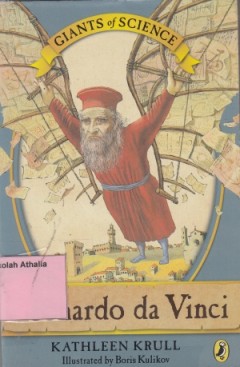
Leonardo da Vinci
For more than thirty years-half his life-da Vinci was obsessively devoted to investigationg everything in the natural world. Nothing escaped his interesrt: how our eyes see, ehy the sky is blue, what forces buld mountains, how light travels, where water comes from, and most fascinating of all to Leonardo-the inner workings of human body. Nothing stopped him. It was illegal to dissect human corp…
- Edition
- -
- ISBN/ISSN
- 978 0 14 240821 6
- Collation
- 124 hlm.: 18 cm.
- Series Title
- GIANT OF SCIENCE
- Call Number
- 925 Kru L
Leonardo da Vinci
For more than thirty years - half his life - da Vinci was obsessively devoted to investigating everything in the natural world. Nothing escaped his interest: how our eyes see, why the sky is blue, what forces build mountains, how light travels, where water comes from, and - most fascinating of all to Leonardo-the inner workings of the human body. Nothing stopped him. It was illegal to dissect h…
- Edition
- -
- ISBN/ISSN
- 978-0-14-240821 6
- Collation
- 124 hal.; 18 cm.
- Series Title
- -
- Call Number
- 823 Kru l

Sigmund Freud
And famous he become. But does he qualify as a "Giant of science"? Certainly his road to greatness had some prculier detours. As a young physician, he was convinced that cocaine was a miracle sure for nervous afflictions. And at one time, he traced the root of all ailments-both physical and emotional-to a single organ... the nose. Yet Kathleen Krull proveds that Sigmund Freud deserves his place…
- Edition
- -
- ISBN/ISSN
- 978 0 14 241266 4
- Collation
- 144 hlm; 21 cm.
- Series Title
- GIANTS OF SCIENCE
- Call Number
- 921 Kru s

The boy who invented TV
Plowing a potato field in 1920, a fourteen-year-old farm boy had a brainstorm. He saw in the parallel rows of overtuned earth a way to "make pictures fly throught the air." And just eight years later, he made his idea a reality when he transmitted the world's first television image. The boy was not a magician; he was a scientific genius. Kathleen Krull's lively text and Greg Couch's inspired…
- Edition
- -
- ISBN/ISSN
- 978 0 385 75557 3
- Collation
- ....hlm; m28 cm
- Series Title
- -
- Call Number
- 926 Kru b

Isaac Newton
Isac Newton was a man with an imagination so large that just "by thinking on it" he invented a new branch of match-calculus-and figured out the scientific explanation of gravity. Yet Newton was so small-minded that he tried to destroy other scientists who dared question, he nonetheless spent for more time trying to predict the future from passages in the bible and to unlock the secret of turnin…
- Edition
- -
- ISBN/ISSN
- 978 0 14 240820 9
- Collation
- 126 hlm; 18 cm.
- Series Title
- GIANTS OF SCIENCE
- Call Number
- 925 Kru i

Marie Curie
The winner of not just one but two Nobel Prizes, Marie Curie died in 1934 of radiation poisoning-from years of investigating the dangerous elements that she herself had discovered. Until, recently, her notebooks wew still so radioactive that scientist and scholars had to dign a medical release before looking at them. ut her work, which led t the atomic age in sceience, was also her salvations;…
- Edition
- -
- ISBN/ISSN
- 978 0 14 241265 7
- Collation
- 142 hlm; 18 cm.
- Series Title
- GIANTS OF SCIENCE
- Call Number
- 925 Kru m
 Computer Science, Information & General Works
  Philosophy & Psychology
  Religion
  Social Sciences
  Language
  Pure Science
  Applied Sciences
  Art & Recreation
  Literature
  History & Geography